
July 4
The Fourth of July has always been one of the most significant dates on the American calendar, bringing together celebrations of freedom, patriotism, and the nation’s founding ideals. In 2026, however, the occasion carried even greater historical importance as the United States celebrated the 250th anniversary of the Declaration of Independence. The milestone attracted millions of Americans to events across the country, with the nation’s capital hosting one of the largest Independence Day celebrations in recent history.
President Donald Trump used the historic occasion to deliver a nationally watched speech that blended celebration with political messaging. Speaking from Washington, D.C., Trump reflected on America’s past achievements while outlining his vision for the country’s future. His remarks touched on economic growth, national security, immigration, military strength, and the importance of preserving American values.
The event was not without unexpected challenges. Severe thunderstorms forced organizers to temporarily pause festivities, delaying the president’s appearance before thousands gathered on the National Mall. Despite the weather disruption, the celebration continued with concerts, patriotic performances, and an impressive fireworks display that capped off the evening.
As expected, Trump’s speech quickly became one of the day’s biggest talking points. Supporters praised its patriotic tone and optimistic outlook, while critics argued that the address blurred the distinction between a national celebration and a political event. Regardless of perspective, the speech reinforced the central role politics now plays during major national occasions.
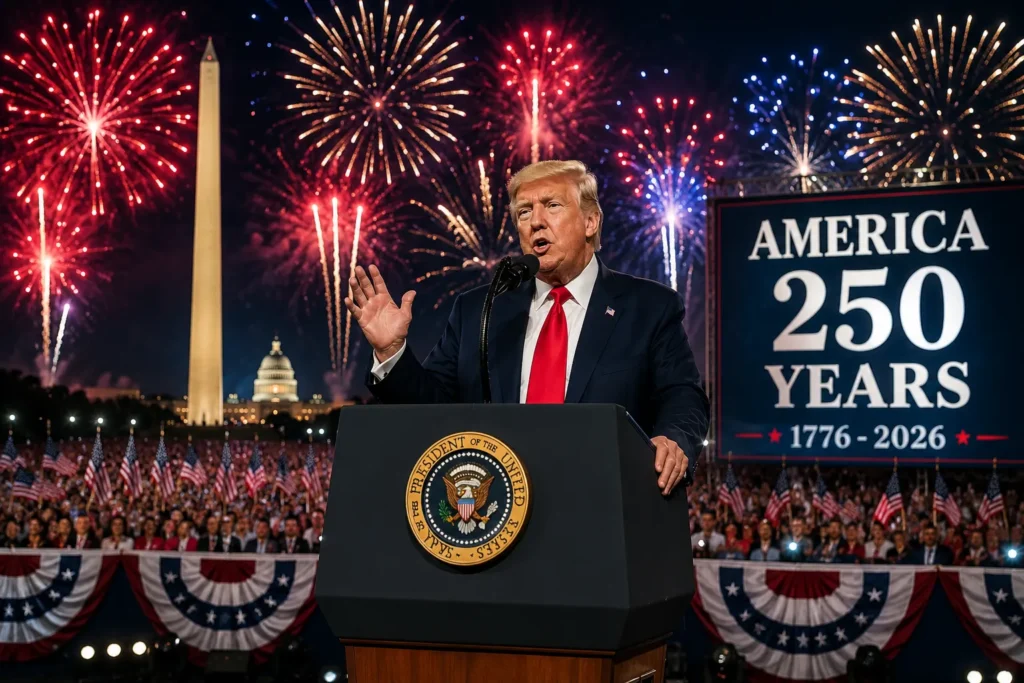
Trump’s July 4 Speech Becomes the Centerpiece of America’s Historic Celebration
The 250th anniversary of American independence represented far more than a traditional Fourth of July holiday. It symbolized a quarter of a millennium since the signing of the Declaration of Independence in 1776, making this year’s celebration one of the most anticipated patriotic events in decades.
Washington, D.C., became the focal point of nationwide festivities. Thousands of visitors traveled from across the country to participate in concerts, military tributes, historical reenactments, and community celebrations before gathering on the National Mall for the evening’s main events.
President Trump addressed the crowd after weather delays pushed the schedule back by nearly two hours. Heavy rain and thunderstorms temporarily cleared portions of the National Mall as organizers worked to ensure public safety.
When the president finally took the stage, he was greeted by enthusiastic supporters waving American flags beneath clearing skies. The dramatic weather delay added anticipation to an address that had already attracted significant national attention.
Rather than delivering a speech focused solely on history, Trump combined reflections on America’s founding principles with commentary on his administration’s accomplishments and priorities. The result was an address that celebrated the nation’s past while presenting a vision for its future.
The speech emphasized themes of resilience, economic prosperity, military readiness, border security, and national unity—topics that have consistently appeared throughout Trump’s presidency.
A Message Built Around Patriotism and National Pride
Throughout the address, President Trump repeatedly praised what he described as America’s exceptional history and enduring strength.
He celebrated the country’s military, recognizing the sacrifices made by active-duty service members and veterans while highlighting the role of the armed forces in protecting national security. Military flyovers and ceremonial tributes throughout the evening reinforced this patriotic message.
Trump also reflected on America’s achievements in science, technology, space exploration, business, and innovation. He argued that the nation’s greatest accomplishments were the result of individual freedom, entrepreneurship, and constitutional government.
The president described the United States as entering what he called a “new golden age,” pointing to economic indicators, manufacturing growth, and investment as evidence that the country was moving in a positive direction.
Another recurring theme involved preserving traditional American values. Trump encouraged citizens to remain proud of the nation’s heritage while continuing to defend freedom, opportunity, and democracy for future generations.
Although patriotic speeches are common during Independence Day celebrations, Trump’s address stood out because it frequently connected historical themes with current political priorities.
For supporters, the speech reinforced confidence in the country’s future and celebrated achievements they believe deserve greater recognition.
Politics Remains at the Heart of the Conversation
While the occasion centered on national celebration, politics inevitably played a major role throughout the evening.
President Trump used portions of his speech to defend his administration’s record on immigration, border enforcement, economic policy, and public safety. He argued that these policies had strengthened the nation and positioned America for continued success.
He also criticized political opponents, suggesting that competing visions for the country could weaken national security and economic competitiveness.
The political tone prompted immediate reactions across television networks and social media platforms.
Supporters viewed the speech as an appropriate opportunity for a sitting president to explain his agenda while celebrating Independence Day.
Critics, however, argued that the address resembled a campaign speech more than a unifying national celebration. They expressed concern that traditionally bipartisan patriotic events are increasingly becoming venues for partisan messaging.
Political analysts noted that the speech arrives during an important period leading toward future elections. Every major presidential appearance now carries added significance, particularly when delivered before a nationwide television audience.
The discussion surrounding the speech illustrates how modern political communication has evolved, with national holidays becoming platforms for broader policy debates.
Weather Delays Could Not Overshadow the Celebration
One of the biggest stories surrounding the event had nothing to do with politics.
Severe thunderstorms swept across Washington, D.C., during the afternoon and evening, forcing officials to suspend outdoor activities temporarily and ask attendees to seek shelter.
The weather delayed the president’s remarks and created uncertainty about whether portions of the celebration—including the planned fireworks display—would proceed as scheduled.
Fortunately, conditions improved later in the evening.
Organizers resumed festivities once it was safe for attendees to return to the National Mall, allowing concerts and ceremonial events to continue.
The fireworks display ultimately lit up the Washington skyline, providing a spectacular conclusion to the historic anniversary celebration.
For many visitors, the delay became part of an unforgettable experience rather than a disappointment.
The evening demonstrated the logistical challenges involved in organizing one of the nation’s largest public celebrations while also highlighting the determination of organizers and attendees to mark the country’s 250th anniversary despite unexpected obstacles.
Television broadcasts captured dramatic images of rain clouds giving way to clear skies just before the festivities resumed, creating memorable scenes that quickly circulated online.
What Trump’s July 4 Address Means Moving Forward
President Trump’s Independence Day speech is likely to remain one of the defining political moments of 2026.
Beyond celebrating America’s founding, the address reflected broader debates shaping the nation’s future. Questions surrounding immigration, economic policy, national identity, public safety, and political leadership continue to dominate public discussion, and many of those issues were woven throughout the president’s remarks.
The speech also underscored how symbolic national events increasingly serve multiple purposes. They celebrate history, honor national achievements, and provide presidents with opportunities to communicate directly with millions of Americans.
As the United States begins the next chapter following its 250th anniversary, observers will continue evaluating how the themes presented during this address influence political conversations in the months ahead.
Whether viewed as an inspiring patriotic tribute or as a highly political Independence Day speech, Trump’s remarks generated widespread discussion across the country. They reminded Americans that major national celebrations often become moments of reflection not only about the nation’s past but also about its future direction.
The Fourth of July has always represented freedom, unity, and national pride. This year’s celebration added another chapter to that tradition, combining historic commemoration with contemporary political debate. For supporters, it showcased optimism and confidence in America’s future. For critics, it highlighted concerns about the growing intersection of politics and national ceremonies.
One thing is certain: President Donald Trump’s July 4 speech ensured that America’s historic 250th Independence Day celebration will be remembered not only for its fireworks and festivities but also for the conversations it sparked across the nation.
Table of Contents
Trump commemorates Fourth of July with speech at Mount Rushmore
Even Republicans Oppose Trump’s Expanded SAVE America Act – trendsfocus