
Election integrity has remained one of the defining political issues in the United States since the 2020 presidential election. Republicans have consistently pushed for stricter voting laws, arguing that stronger safeguards are necessary to maintain public confidence in the electoral process. Democrats, meanwhile, have warned that many of these proposals could make it harder for eligible Americans to vote.
At the center of the latest debate is President Donald Trump’s expanded vision for the SAVE America Act. While many Republicans support requiring proof of citizenship to register for federal elections, Trump’s broader demands—including additional election reforms tied to the legislation—have created an unexpected obstacle: resistance from members of his own party.
The disagreement has grown into one of the most significant internal Republican disputes of 2026, delaying legislative business in the House of Representatives and exposing the political challenges GOP leaders face as they attempt to balance Trump’s priorities with the realities of governing.
This article examines what the SAVE America Act is, why Trump wants a broader version, why Republicans are divided, and what the dispute could mean for future elections.
What Is the SAVE America Act?
The SAVE America Act—often referred to simply as the SAVE Act—was introduced as legislation designed to prevent non-U.S. citizens from registering to vote in federal elections.
Federal law already prohibits non-citizens from voting in federal elections. However, supporters of the bill argue that requiring documentary proof of citizenship during voter registration would strengthen confidence in the electoral system and eliminate any possibility of ineligible voting.
The House-approved version of the legislation generally focuses on requiring applicants to provide documentation proving U.S. citizenship before registering to vote.
Supporters argue that acceptable documents could include:
- A U.S. passport
- A certified birth certificate
- Naturalization documents
- Other federally recognized proof of citizenship
Republicans backing the legislation say election integrity should be protected before problems emerge rather than after they occur.
Opponents, however, argue that documented cases of non-citizen voting are already extremely rare and that additional requirements could unintentionally prevent eligible citizens from registering.
These concerns have fueled years of debate over balancing election security with voter accessibility.
Why Trump’s Expanded Proposal Is Creating Republican Opposition
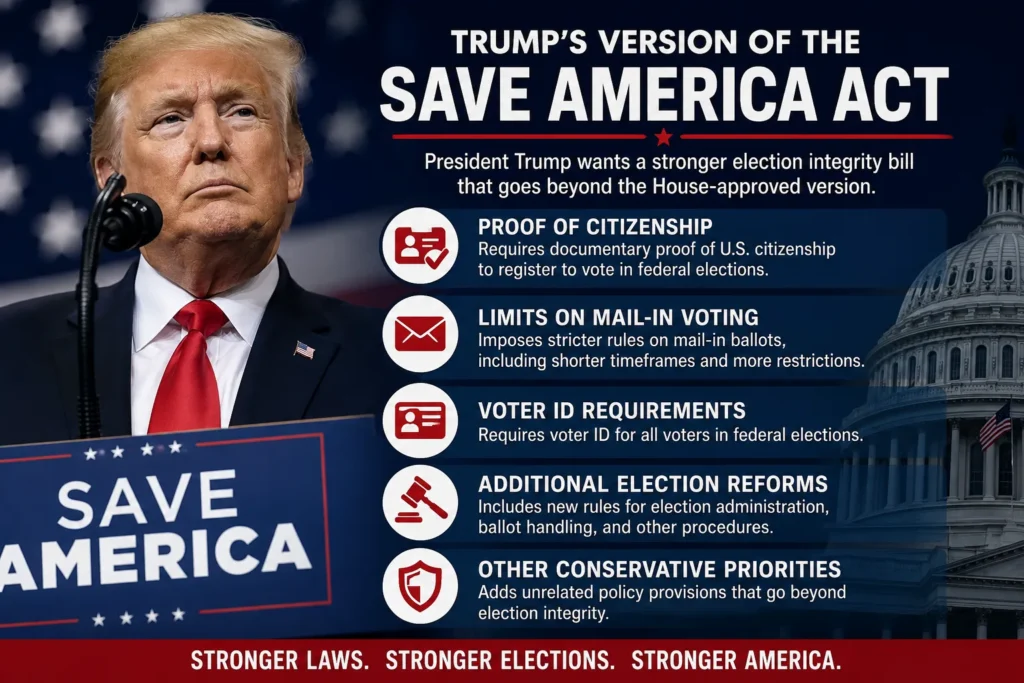
While most congressional Republicans support the basic concept of requiring proof of citizenship, President Trump has pushed for a significantly broader package.
His preferred version reportedly goes beyond citizenship verification by including additional election reforms such as:
- Stricter voter identification requirements
- Limits on certain forms of mail voting
- Additional election administration reforms
- Other conservative legislative priorities tied to election law
For Trump, combining these provisions represents a comprehensive approach to election security.
Many Republicans, however, see political risks.
Several lawmakers worry that adding controversial provisions makes the legislation much harder to pass through Congress.
Others believe the expanded package could alienate moderate voters ahead of the 2026 midterm elections.
Republicans from states where mail voting is widely used—even among GOP voters—have expressed concern that stricter restrictions could unintentionally affect their own supporters.
Some lawmakers also argue that expanding the bill shifts attention away from its central objective of citizenship verification.
Rather than improving its chances, they fear additional provisions could doom the legislation altogether.
The disagreement illustrates an important reality within today’s Republican Party: while election security remains a unifying issue, there is growing disagreement over strategy.
How the Dispute Has Affected Congress
The conflict surrounding Trump’s preferred version of the SAVE America Act has reached beyond policy disagreements and begun affecting the legislative process itself.
House Republicans hold only a narrow majority, meaning party unity is often essential to advancing legislation.
In recent days, disagreements over Trump’s election priorities contributed to procedural votes failing in the House.
Those setbacks delayed consideration of several unrelated measures, including major defense legislation.
The legislative gridlock highlighted the challenge facing Republican leadership.
House leaders have attempted to negotiate a compromise that would satisfy both Trump’s allies and more moderate Republicans.
Speaker Mike Johnson has acknowledged that the party does not yet have sufficient support for Trump’s broader proposal.
That reality has forced Republican leadership to consider whether to:
- Move forward with the narrower House version,
- Continue negotiating changes,
- Or delay action until broader consensus can be reached.
Meanwhile, Democrats have remained united in opposition, arguing that the legislation creates unnecessary voting barriers without addressing a widespread problem.
Because Republicans cannot afford many defections, even a relatively small number of dissenting GOP lawmakers has become enough to stall progress.
The situation demonstrates how narrow congressional majorities can amplify internal party disagreements.
What This Means for the 2026 Elections and Beyond
The debate over Trump’s version of the SAVE America Act is about more than a single piece of legislation.
It reflects broader questions about the future direction of Republican election policy.
If Congress ultimately passes a narrower version of the bill, it could represent a compromise between election security advocates and Republicans seeking broader political appeal.
If negotiations collapse entirely, it may become another example of how internal divisions can prevent even majority parties from advancing major priorities.
The outcome could also influence campaign messaging heading into the 2026 midterm elections.
Republicans are likely to continue emphasizing election integrity as a central issue.
Democrats are expected to campaign on protecting voting access and opposing what they describe as unnecessary restrictions.
Independent voters may ultimately determine which message resonates more strongly.
The dispute also highlights President Trump’s continued influence within the Republican Party.
Although many Republican lawmakers remain loyal to the president, recent events suggest that not every policy preference automatically receives unanimous GOP support.
As Congress continues debating election legislation, observers will be watching whether Republicans can unite behind a common strategy or whether internal disagreements continue to shape the legislative agenda.
Whatever happens, the controversy surrounding the SAVE America Act demonstrates that election policy remains one of the most politically sensitive and consequential issues in American politics.
To Conclude
The debate over President Trump’s preferred version of the SAVE America Act has exposed a rare but significant divide within the Republican Party. While there is broad agreement among GOP lawmakers on the importance of protecting election integrity, there is far less consensus on how expansive new federal voting laws should be.
Trump’s push for a more comprehensive package has energized supporters who believe stronger safeguards are necessary, but it has also raised concerns among Republicans who fear the proposal is too broad, politically risky, or unlikely to pass the Senate. The resulting disagreement has already disrupted House business and underscored the challenges of governing with a narrow majority.
As lawmakers continue negotiations, the future of the SAVE America Act remains uncertain. Whether Congress ultimately adopts a narrower compromise or the legislation stalls altogether, the debate is likely to shape the national conversation on election law well beyond the 2026 midterm elections. It also serves as a reminder that even within a unified party, differing political strategies and legislative priorities can significantly influence the path of major policy initiatives.
Table of Contents
Anything but SAVE America Act is a ‘big yawn’ to Trump
Air Force Major Arrested on Capitol Steps During Impeachment Protest – trendsfocus