
Tensions are building ahead of the 25th anniversary of the September 11 attacks after Nassau County Executive and Republican gubernatorial candidate Bruce Blakeman publicly criticized New York City Mayor Zohran Mamdani’s expected attendance at the annual 9/11 memorial ceremony.
Blakeman has said he intends to turn his back on Mamdani during the ceremony and has encouraged others who share his concerns to do the same. His remarks have drawn attention because the September 11 commemoration is traditionally centered on remembrance, mourning, and honoring the nearly 3,000 people who were killed in the 2001 terrorist attacks.
The dispute also carries a personal dimension for Blakeman, who lost a nephew on September 11, 2001. He has argued that Mamdani’s political positions and past statements make his presence at the memorial inappropriate. Mamdani, however, has maintained that he intends to attend the event to honor the victims, survivors, first responders, and families affected by the attacks.
As the anniversary approaches, the disagreement has become part of a broader debate about politics, public remembrance, and whether elected officials should be welcomed at solemn memorial events even when some victims’ families strongly oppose their presence.
Blakeman Targets Mamdani Over 9/11 Memorial
Bruce Blakeman has intensified criticism of New York City Mayor Zohran Mamdani ahead of the upcoming September 11 memorial ceremony, saying he plans to physically turn his back when Mamdani is present.
The gesture is intended as a peaceful protest, according to Blakeman, who has urged others who feel similarly to express their opposition in the same way.
His comments have sparked a significant political and emotional debate in New York, particularly because of the setting in which the protest would take place.
The annual ceremony at the National September 11 Memorial in Lower Manhattan is one of the most solemn public events in the United States. Families gather to remember loved ones, names of victims are read aloud, and moments of silence mark the exact times when key events unfolded on September 11, 2001.
For many participants, the ceremony is intentionally kept separate from ordinary political events.
Blakeman, however, argues that Mamdani’s presence itself creates a political and emotional conflict.
He has criticized the mayor over comments and political positions related to the Israeli-Palestinian conflict, including controversies surrounding the phrase “globalize the intifada.” Critics of the phrase argue that it can be understood as endorsing or encouraging political violence, while others interpret it differently in political and activist contexts.
Blakeman has argued that Mamdani has not gone far enough in condemning the phrase and believes that this makes his appearance at the September 11 memorial objectionable.
Mamdani and his supporters have pushed back against broader efforts to characterize his political views as supportive of violence.
The dispute has therefore become about more than one ceremony. It reflects larger disagreements in New York politics involving public language, foreign policy, identity, protest, and the responsibilities of elected officials.
Why Bruce Blakeman Opposes Mamdani’s Attendance
Bruce Blakeman’s opposition to Mamdani attending the memorial is deeply personal.
Blakeman lost his nephew in the September 11 attacks, giving him a direct family connection to the tragedy. He has spoken about the pain experienced by victims’ families and has argued that their views should carry significant weight when deciding who participates in anniversary events.
According to Blakeman, Mamdani’s attendance would make some families uncomfortable and could distract from the purpose of the ceremony.
He has compared the situation to attending a wake despite objections from grieving relatives, suggesting that public office does not automatically give a political figure the moral right to be present at every commemorative event.
That argument has resonated with some relatives of 9/11 victims.
A petition calling for Mamdani not to attend the ceremony has reportedly attracted tens of thousands of signatures. Supporters of the petition say that his presence could be upsetting to families who disagree strongly with his political views and past statements.
At the same time, the petition does not necessarily represent every 9/11 family.
Families affected by the attacks are not politically uniform, and views about Mamdani’s attendance vary.
Some may believe his presence is inappropriate, while others may consider the event a civic ceremony that should include New York City’s elected mayor regardless of political differences.
That division is important because the September 11 attacks affected a vast and diverse group of people.
Victims came from many backgrounds, religions, nationalities, and political perspectives. Their surviving relatives also hold a wide range of views.
Blakeman’s planned protest, therefore, is likely to be seen in very different ways.
Supporters may view turning away from Mamdani as a restrained and respectful way to register disapproval without disrupting the ceremony.
Critics may argue that even a silent protest introduces political conflict into a day that should remain focused entirely on the victims.
That tension is at the heart of the controversy.
Mamdani Says He Plans to Attend the September 11 Ceremony
Despite the criticism, Mamdani has indicated that he intends to attend the memorial ceremony.
From his perspective, participation is part of his responsibility as mayor of New York City.
September 11 is not only a national tragedy but a defining event in the history of New York. The attacks transformed the city, reshaped its emergency services, changed security policies, and left a lasting impact on thousands of families.
The mayor of New York traditionally plays a visible role in commemorative events connected to the attacks.
Mamdani has said that he wants to honor those who were killed, recognize first responders, remember survivors, and acknowledge the families who continue living with the consequences of the tragedy.
His decision to attend suggests that he does not believe political disagreement should prevent him from participating in an official civic remembrance.
That position creates a difficult question.
Should an elected leader stay away from an important public memorial because some grieving families object to his political views?
Or should the leader attend because he represents the city and the ceremony belongs to the broader public as well as individual families?
There is no easy answer.
The September 11 ceremony occupies an unusual space. It is both deeply personal and highly public.
For relatives of victims, it can feel like a funeral anniversary.
For the city, it is an official day of remembrance.
For political leaders, it is also part of their civic responsibility.
These different meanings can come into conflict.
Mamdani’s participation will likely be watched closely, especially if Blakeman and others follow through on plans to turn their backs.
Whether that protest becomes a major visual moment or remains relatively quiet could shape public discussion surrounding this year’s commemoration.
The 25th Anniversary Makes This Year Especially Significant
The upcoming ceremony carries additional emotional weight because it marks 25 years since the attacks of September 11, 2001.
A quarter-century has passed since hijacked planes struck the World Trade Center in New York and the Pentagon, while another plane crashed in Pennsylvania after passengers and crew members attempted to regain control.
Nearly 3,000 people were killed.
Thousands more have since suffered health consequences linked to toxic exposure at and around Ground Zero.
First responders, construction workers, residents, survivors, and others who were exposed to dust and debris have faced long-term illnesses, including respiratory diseases and cancer.
Because of those continuing deaths, the meaning of September 11 remembrance has expanded over time.
The memorial is no longer only about those who died on the day of the attacks. It also recognizes people who later lost their lives because of illnesses connected to the aftermath.
This year, an additional moment of silence is expected to honor those individuals.
That broader recognition highlights how the effects of September 11 continue to be felt decades later.
The 25th anniversary is therefore likely to receive even greater national and international attention than an ordinary annual ceremony.
Political controversy surrounding attendance could receive significant media coverage, but many families are likely to hope that it does not overshadow the purpose of the day.
That concern is understandable.
Anniversaries such as the 25th often become moments of reflection.
People remember where they were when the attacks happened, how the country reacted, and how life changed afterward.
Younger generations who were not alive in 2001 also increasingly rely on memorials, museums, schools, documentaries, and family stories to understand what happened.
As time passes, ceremonies like this become important not only for grief but also for historical memory.
That makes questions about tone, behavior, and political expression particularly sensitive.
The Dispute Raises a Bigger Question About Politics and Remembrance
The disagreement between Bruce Blakeman and Zohran Mamdani highlights a broader issue that extends beyond these two political figures.
How much politics should be allowed into public memorial events?
In one sense, politics is almost impossible to remove completely.
Elected officials attend ceremonies because they represent governments and communities. Their presence is inherently connected to public life.
At the same time, memorial events often depend on political restraint.
Families attending to mourn may not want campaign disputes, ideological arguments, or partisan demonstrations to dominate the day.
Blakeman’s proposed protest sits somewhere between those two positions.
Turning one’s back is silent.
It does not involve shouting, interrupting speakers, carrying large signs, or preventing the ceremony from proceeding.
That may be why Blakeman considers it an appropriate form of protest.
However, even a silent gesture can become highly visible, especially when cameras are present.
If large numbers of attendees turn away from the mayor, the moment could become one of the defining images of the anniversary.
That could shift media attention from remembrance toward political confrontation.
Whether that would be justified depends largely on perspective.
Blakeman and his supporters believe they are defending the dignity of the families and objecting to someone they believe should not attend.
Mamdani and his supporters may view his attendance as a legitimate and expected responsibility of the city’s mayor.
Others may disagree with both sides and simply hope that the ceremony proceeds without becoming another front in an increasingly polarized political environment.
The debate demonstrates how difficult public remembrance can become when history, grief, politics, and identity intersect.
Twenty-five years after September 11, the attacks remain emotionally powerful in American public life.
The memorial ceremony continues to serve as a place where names are remembered, families gather, first responders are honored, and the city reflects on one of the darkest days in its history.
Whatever happens between Blakeman and Mamdani at the ceremony, the central meaning of the anniversary remains the same.
It is about the people who were killed, the families who lost loved ones, the first responders who risked their lives, the survivors who carried the experience forward, and those who later became ill because of the aftermath.
Political disputes may dominate headlines in the weeks before September 11.
But for many New Yorkers and Americans, the most important goal will be making sure the people at the heart of the tragedy are not forgotten.
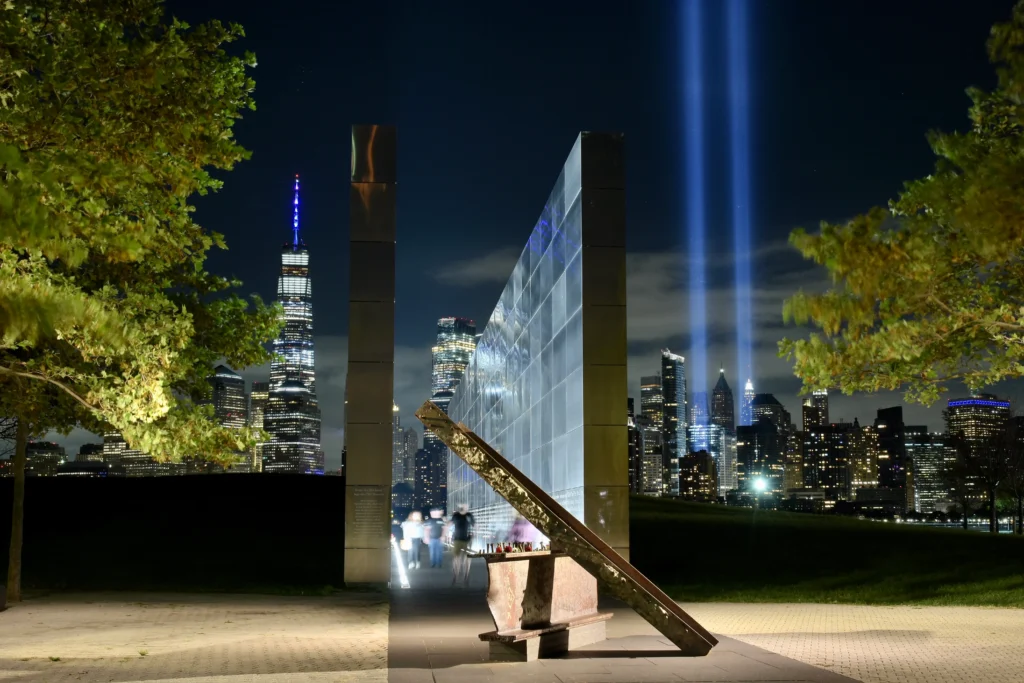
Table of Contents
Bruce Blakeman says he’ll turn his back on Mamdani at 9/11 memorial
Zohran Mamdani Booed During Major Pro-Police Event on Staten Island – trendsfocus