
What happened during the at-sea resupply operation?
The collision occurred during a procedure known as replenishment-at-sea (also called underway replenishment). This is when ships transfer fuel, supplies, and sometimes equipment while both vessels remain in motion—often traveling side-by-side at a matched speed.
If you picture two massive ships moving in parallel with only a controlled gap between them, you’re already close to the reality. During replenishment, crews have to keep:
- Stable speed (even a small change can shift spacing)
- Stable course (unexpected drift can close distance)
- Constant communication (bridge-to-bridge and deck teams)
- Precise positioning (because hoses and lines are under tension)
In this incident, the vessels involved were:
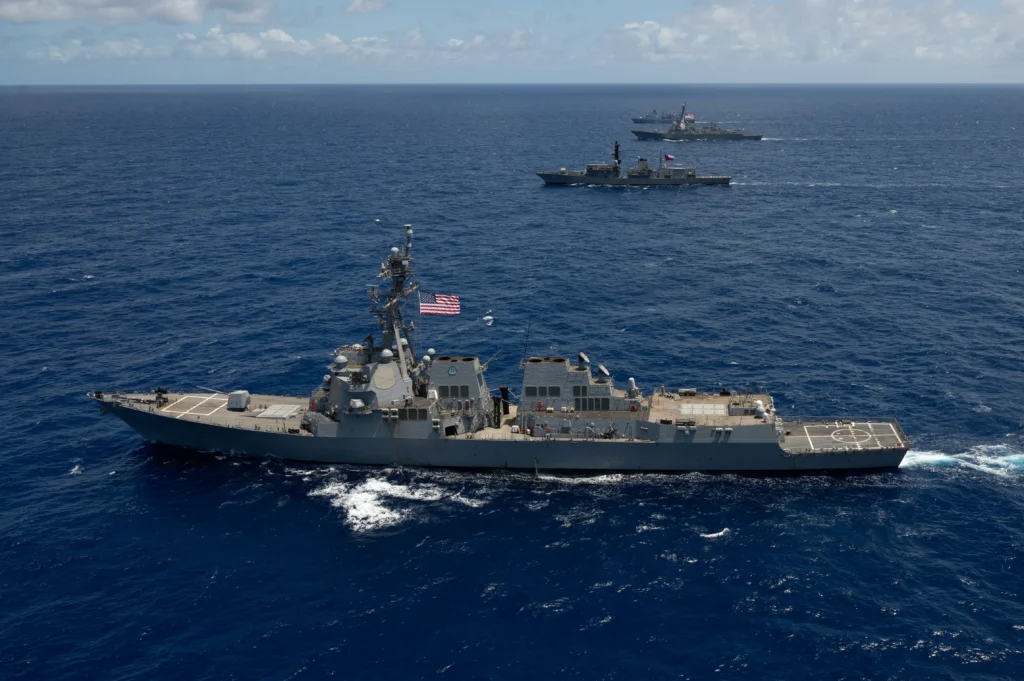
- USS Truxtun (DDG-103) — a guided-missile destroyer built for multi-mission operations
- USNS Supply (T-AOE-6) — a fast combat support ship designed to keep fleets fueled and stocked
Even though replenishment happens regularly, it’s not casual. It’s closer to a carefully choreographed maneuver—done at sea, in real conditions, with real variables.
Why this kind of operation is harder than it looks
From the outside, it might seem like ships can simply “slow down and be careful.” But in many naval situations, you can’t just stop in place. Ships keep moving to maintain control, reduce drift, and stay operationally flexible.
During replenishment, you’re dealing with forces that can change quickly, such as:
- Wind pressure pushing the ship sideways
- Swell and wave action creating rolling and yawing motion
- Current pulling the hull off a perfect line
- Hydrodynamic interaction where two ships close together can affect each other’s movement in subtle ways
That’s why these operations rely on repeated training and strict procedures. And it’s exactly why a collision—while uncommon—can still happen.
What you should take away here
If you’re trying to understand the headline without the noise, remember this: the collision happened during a close-quarters logistics maneuver, not during combat. It was an operational incident during a high-precision task.
Where did it happen, and why were the ships operating there?
The collision took place in waters described as near South America, within the broader Caribbean region, an area often tied to U.S. Southern Command responsibilities.
If you’re wondering why U.S. Navy ships operate there at all, the short answer is: presence, partnerships, and sustained missions. Naval forces don’t only deploy for war. They also operate for:
- Maritime security and deterrence
- Regional cooperation with partners
- Surveillance and patrol operations
- Logistics support for ongoing missions
- Maintaining readiness and flexibility in key sea lanes
Why logistics ships matter more than most people realize
You can think of a destroyer like USS Truxtun as a high-performance machine built for demanding tasks. But it can’t stay out at sea without support. A ship like USNS Supply helps extend operational time by delivering:
- Fuel (sometimes multiple types)
- Food and essentials
- Spare parts
- Other critical supplies
If you follow naval strategy even casually, you’ll hear a recurring theme: logistics wins endurance. Without resupply, deployments shrink. With resupply, ships can stay on station longer and react faster.
A note on operational details
In many naval incidents, you won’t get every detail immediately—like exact coordinates, exact sequence of maneuvers, or what was said between teams in real time. That information is often reviewed internally first. What matters for you as a reader is the operational context:
- Two ships were conducting a close-distance replenishment task
- The incident occurred in a region where U.S. forces routinely operate
- The aftermath triggered safety checks and an investigation
Injuries, ship condition, and the immediate response
Whenever ships collide, the two questions you want answered right away are:
- Was anyone hurt?
- Are the ships safe and controllable?
In this case, officials reported two personnel suffered minor injuries, and they were described as stable. That’s important, because even “minor” injuries in a shipboard setting can include falls, line-related impacts, or sudden jolts during an unexpected contact event.
Were the ships seriously damaged?
Early information indicated that both ships remained able to sail safely after the collision. That doesn’t automatically mean “no damage.” It usually means:
- The ships can maintain propulsion and steering
- There’s no immediate threat to hull integrity that forces an emergency stop
- Critical onboard systems remain functional enough to proceed safely
When a collision happens, crews typically move into a structured response that can include:
- Securing stations and accounting for personnel
- Medical checks and treatment
- Immediate damage control inspections
- Checking propulsion, steering, and navigation systems
- Assessing hull sections near the point of contact
- Confirming that replenishment gear, lines, and deck equipment are safe
Why “minor” injuries still matter
If you’re thinking like a safety-minded reader (and you should), minor injuries still signal something serious: the margin for error tightened quickly.
Replenishment operations are designed to minimize risk, but when a collision occurs, it can cause:
- Sudden shifts that throw people off balance
- Equipment snaps or unexpected tension changes
- Quick response movements in confined areas
- Higher stress that increases the chance of secondary mishaps
The fact that the ships remained operational is a positive sign. Still, the Navy typically treats any collision as a major learning event—because the next one might not be as forgiving.
What happens after the first safety checks
After the immediate “all clear,” the process often moves into more detailed inspection and reporting. That can affect:
- Mission schedules
- Port calls
- Maintenance timelines
- Crew rotations
- Future replenishment procedures
Even if ships are seaworthy, they may still require repairs or inspections before resuming certain tasks.
What happens next, and why this collision matters beyond the headline
You might be tempted to treat this as a one-day story: two ships collided, two people got minor injuries, everyone moves on. In reality, collisions trigger a bigger chain of follow-up—especially in professional naval forces.
The investigation: what it usually looks at
A formal investigation generally aims to answer one core question: What combination of factors allowed this to happen? It’s rarely just one mistake. Investigators typically examine:
- Shiphandling decisions
- Speed changes, course corrections, distance management
- Bridge team communication
- Clarity of orders, timing, confirmation practices
- Coordination between ships
- Who had control of what decisions and when
- Environmental conditions
- Visibility, sea state, wind, current
- Equipment performance
- Navigation systems, steering response, sensors
- Procedural compliance
- Whether standard replenishment steps were followed
- Human factors
- Fatigue, workload, situational awareness under pressure
If you’ve ever seen how aviation investigates incidents, the mindset is similar: find the cause, tighten the system, reduce repeat risk.
Why replenishment-at-sea is strategically important
Here’s the bigger picture you should keep in mind: replenishment is one of the reasons naval forces can operate globally. It supports:
- Longer deployments without constant port stops
- Faster response to crises
- Persistent presence in strategic regions
- Operational flexibility when situations change
So when a replenishment operation leads to a collision, it matters because it touches a core capability: sustained operations at distance.
What changes after a collision
Depending on findings, the Navy may implement changes such as:
- Updated training requirements for bridge teams
- Revised safety buffers or speed guidance
- More stringent communication protocols
- Additional checks before replenishment begins
- Refresher drills focused on close-quarters maneuvering
You may not see every internal change publicly, but the ripple effects often show up in how procedures are reinforced.
Quick questions you’re probably asking
Can this happen even with modern technology?
Yes—because technology supports decisions, but it doesn’t replace human judgment during tight maneuvers.
Does this mean ships are unsafe?
Not automatically. It means the operation carries risk, and the system is built to investigate and improve when incidents occur.
Is it unusual?
Collisions aren’t everyday events, which is exactly why they draw attention and prompt formal review.
Call to action
If you want to stay sharp on defense and maritime stories like this—without drowning in jargon—bookmark this blog and check back for updates. And if you’ve ever wondered how naval operations work behind the scenes, tell me in the comments: Do you want a simple explainer on replenishment-at-sea, or a breakdown of how investigations typically unfold after shipboard incidents?
Table of Contents
Two US Navy ships collide in waters near South America
James Van Der Beek Death News: Age, Career, and Reactions – trendsfocus