
The U.S. Naval Academy is more than just an institution. It’s a symbol of honor, duty, and leadership, standing proudly as one of the most prestigious military academies in the world. Established in 1845, this institution has played a pivotal role in shaping the United States Navy and producing countless leaders who have served the nation with distinction. In this article, you’ll explore how the U.S. Naval Academy came to be, the challenges it faced during its early years, and the remarkable legacy it continues to build today.
Why Was the U.S. Naval Academy Established?
The story of the U.S. Naval Academy begins in the early 19th century when the United States was still a young nation, striving to make its mark on the global stage. The Navy was underdeveloped, and the training for naval officers was informal at best, which often led to unqualified individuals commanding ships and naval missions. The country faced growing tensions with other world powers, and the need for an organized, skilled Navy became clear.
The State of the U.S. Navy Before the Academy
Before the U.S. Naval Academy opened its doors, naval education in the United States was limited. Officers learned on the job or through informal apprenticeships, which meant that many lacked formal education in critical areas such as navigation, engineering, and tactics. This lack of professional training contributed to the inefficiencies of the Navy, and in times of conflict, it was clear that a more structured approach to officer training was necessary.
Secretary of the Navy George Bancroft: The Driving Force
Enter George Bancroft, the Secretary of the Navy under President James K. Polk. Bancroft recognized that the U.S. Navy needed a dedicated institution to provide officers with the education and training they needed to excel in their roles. He was determined to create an academy that would not only teach naval skills but also instill a sense of discipline, leadership, and patriotism. Bancroft’s vision was realized on October 10, 1845, when he officially established the U.S. Naval Academy in Annapolis, Maryland.
Addressing National Security
At its core, the founding of the U.S. Naval Academy was about national security. The United States needed to modernize its Navy to compete with other global powers. Having an institution that could train highly skilled officers was seen as the key to improving the strength of the U.S. Navy. The academy would provide structured education in essential fields like navigation, engineering, and military tactics, ensuring that future naval officers were prepared for any challenge they might face on the high seas.
The Founding Year (1845)
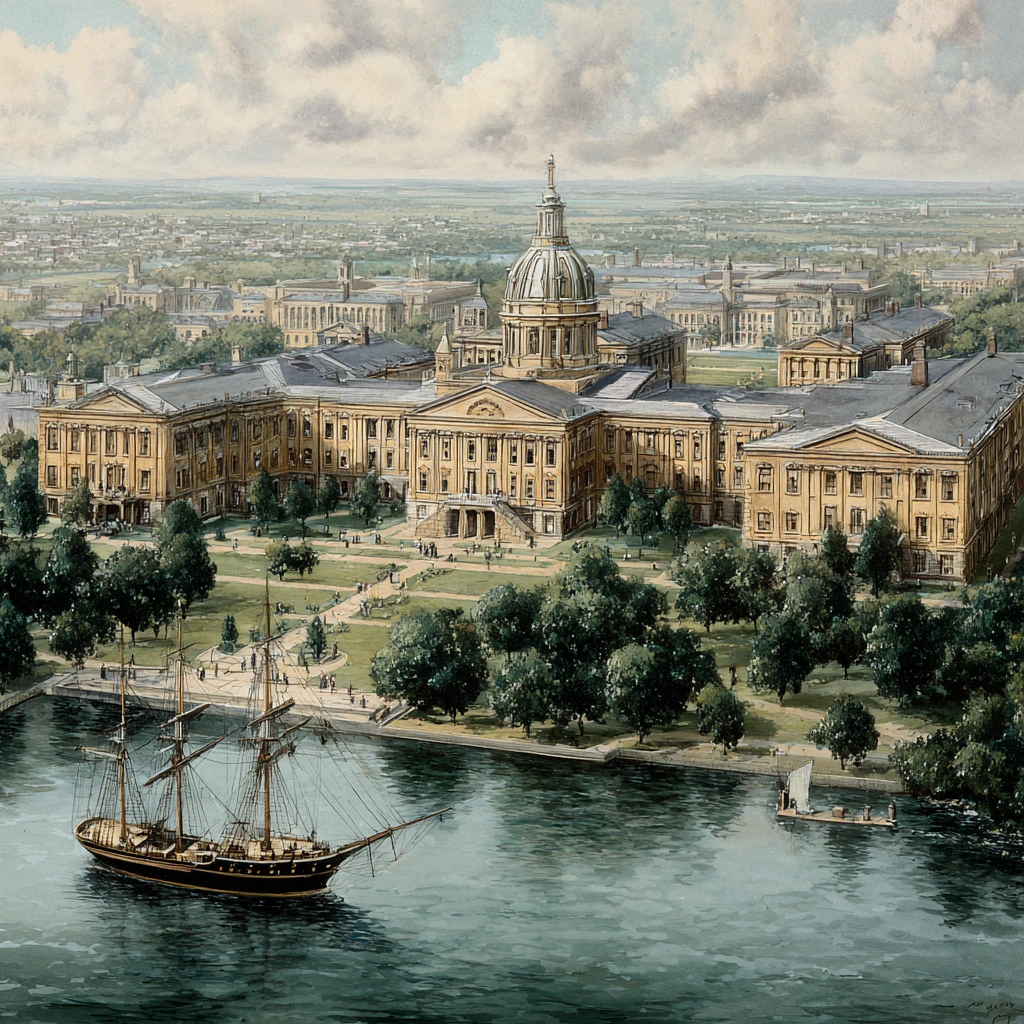
The establishment of the U.S. Naval Academy in 1845 marked the beginning of a new era for naval education in the United States. However, creating the academy was just the first step. Let’s take a closer look at how this institution came to life in the mid-1800s.
The Creation of the Academy
The location of the U.S. Naval Academy in Annapolis, Maryland, was strategic, as it provided easy access to the waters of the Chesapeake Bay, which allowed cadets to practice on the water. The academy was initially housed in a former college building, but as its reputation grew, so did the facilities. Bancroft’s decision to establish the academy at this location played a key role in its success.
In the first few years, the academy struggled to find the necessary resources, both financial and logistical, to establish itself fully. Still, its impact was immediate. The early years were filled with challenges, but these were the growing pains of an institution that would eventually become a global leader in naval education.
The First Class of Midshipmen
The first class of midshipmen—the term for cadets at the academy—was relatively small, but it laid the foundation for the academy’s future success. With just 50 midshipmen, the academy focused on providing rigorous training that blended theoretical education with practical skills.
The curriculum in 1845 was focused on subjects such as navigation, mathematics, engineering, and seamanship. The academy’s early courses were a mix of traditional academic subjects and military training, ensuring that cadets were well-prepared for both the intellectual and tactical challenges they would face as naval officers.

Challenges Faced by the U.S. Naval Academy in its Early Years
Like any institution, the U.S. Naval Academy faced significant challenges during its formative years. From financial struggles to resistance from parts of the Navy establishment, it wasn’t an easy path. However, the academy’s founders were determined to succeed, and their perseverance paid off.
Logistical and Financial Struggles
From the beginning, the U.S. Naval Academy was faced with a lack of resources. The U.S. government didn’t immediately provide adequate funding, and as a result, the academy had to rely on donations and limited funds. The initial facilities were also insufficient for the growing needs of the institution.
However, despite these financial challenges, the academy’s reputation began to spread. As the U.S. Navy grew and more officers began to pass through the academy, the institution proved its value. Over time, the government began to allocate more funding, and the academy’s infrastructure was improved.
Conflict with Naval Tradition
Some of the existing naval officers were skeptical about the necessity of the academy. Many believed that naval officers should learn on the job, as they had done for generations. There was a strong tradition of apprenticeship, and the idea of a formal academy that emphasized education over hands-on experience was met with resistance.
However, as the Navy continued to modernize, the academy’s value became more apparent. The U.S. Naval Academy produced officers who were better trained, better educated, and better prepared for leadership roles. These officers proved their worth on the battlefield, and over time, the academy’s critics were silenced.
Struggle for Credibility
At first, the U.S. Naval Academy struggled to establish its credibility. Many questioned whether the institution could truly provide the level of education and training required to produce competent naval officers. However, over time, as more and more successful graduates emerged, the academy’s reputation grew stronger.
The proof of the academy’s worth came in the form of its graduates’ achievements. Many went on to serve with distinction in the U.S. Navy, contributing to the success of the nation’s naval operations.
The Evolution of the U.S. Naval Academy
As the U.S. Naval Academy grew, so did its curriculum and its influence on the United States Navy. The academy’s evolution is a testament to its adaptability and commitment to excellence in education.
Expansion and Growth Over Time
In the late 19th and early 20th centuries, the U.S. Naval Academy began to expand its curriculum. What began as a focus on basic naval skills soon evolved to include more advanced subjects such as international relations, modern warfare, and technology. The academy’s physical facilities also grew, with new buildings and training facilities being added.
This expansion reflected the changing needs of the Navy and the nation. As the United States became more involved in global conflicts, the demand for well-educated and skilled officers increased. The academy adapted to these needs by continually updating its curriculum and embracing new ideas.
Adapting to Modern Needs
In recent decades, the U.S. Naval Academy has embraced new fields of study, including cyber warfare, nuclear engineering, and military strategy. As the world has become more interconnected and technology-driven, the academy has incorporated these emerging fields into its curriculum.
The introduction of modern training programs in these areas has allowed the academy to produce officers who are not only prepared for traditional naval warfare but also for the challenges of the modern military landscape.
The U.S. Naval Academy’s Impact on American Society
The U.S. Naval Academy is more than just a training ground for naval officers. It has had a profound impact on American society and the world, producing leaders who have shaped the course of history.
Training Leaders for War and Peace
The academy’s graduates have gone on to become some of the most influential figures in U.S. military and political history. Admirals, generals, and politicians who served with distinction were all educated at the U.S. Naval Academy. Their leadership has had a lasting impact on both the U.S. Navy and the country as a whole.
The Academy’s Influence on U.S. Naval Strength
The U.S. Naval Academy has played a key role in ensuring the strength of the U.S. Navy. By providing the Navy with highly skilled and educated officers, the academy has contributed directly to the country’s ability to project power and defend its interests across the globe.
A Symbol of Service, Honor, and Commitment
At its core, the U.S. Naval Academy is about more than just education. It is about instilling the values of honor, courage, and commitment in those who pass through its doors. These values have not only shaped the academy’s graduates but have also shaped the nation. The U.S. Naval Academy stands as a beacon of American values, commitment to service, and dedication to protecting freedom.
FAQ: All You Need to Know About the U.S. Naval Academy (1845)
- What was the main reason for the founding of the U.S. Naval Academy?
- The U.S. Naval Academy was established to provide professional training for naval officers, addressing the gap in formal education and enhancing the nation’s naval strength.
- Where is the U.S. Naval Academy located?
- The U.S. Naval Academy is located in Annapolis, Maryland, on the Severn River, providing easy access to the Chesapeake Bay.
- Who was responsible for founding the U.S. Naval Academy?
- George Bancroft, Secretary of the Navy, is credited with founding the U.S. Naval Academy in 1845.
- What subjects were taught in the early years of the U.S. Naval Academy?
- Early subjects included navigation, mathematics, engineering, and seamanship, all critical to preparing officers for leadership roles.
- How has the U.S. Naval Academy changed over time?
- Over the years, the U.S. Naval Academy has expanded its curriculum to include modern fields such as cyber warfare, international relations, and nuclear engineering.
- How does the U.S. Naval Academy contribute to U.S. naval strength?
- The U.S. Naval Academy has been crucial in producing highly
Table of Contents
https://www.trendsfocus.com/www-trendsfocus-com-morning-routine-for-succes/