
Jules Verne, often hailed as the “Father of Science Fiction,” wasn’t just a storyteller — he was a visionary whose imagination transcended the limits of his time. His adventurous novels have inspired generations, predicting future technologies like submarines, space exploration, and deep-sea diving long before they became reality. His works continue to captivate readers, thinkers, and innovators today, blending adventure, scientific curiosity, and bold imagination. If you’ve ever wondered how a writer from the 19th century could foresee such far-reaching concepts, then you’re in for a journey. Let’s dive into the world of Jules Verne, the visionary of the future, and explore how his ideas shaped our present and will continue to inspire the future.
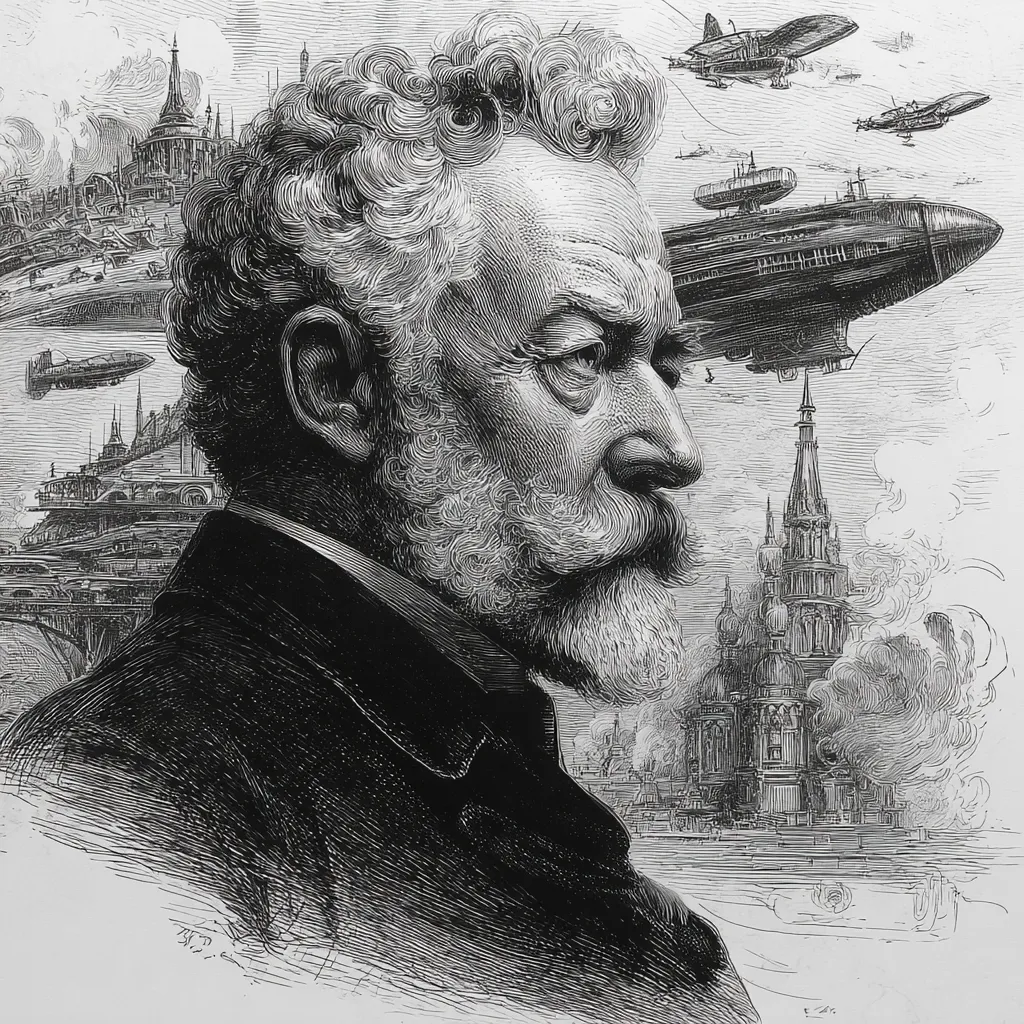
Who Was Jules Verne? A Snapshot of His Life and Legacy
Jules Verne was born in 1828 in Nantes, France, at a time when the world was on the brink of profound change. The Industrial Revolution was reshaping economies and societies, with new technologies and scientific breakthroughs emerging at a rapid pace. Although Verne initially studied law at his father’s request, his heart was set on writing, and in the mid-1800s, he started his literary career.
By the time he was 40, Verne had become a prolific writer. His first novel, Five Weeks in a Balloon (1863), showcased his talent for blending adventure with emerging scientific knowledge. But it was Twenty Thousand Leagues Under the Sea (1870) and Journey to the Center of the Earth (1864) that solidified his place in literary history. His work was often described as prophetic, capturing the human desire to push beyond known limits.
What made Verne stand out was his deep knowledge of science and technology. While many writers of his time wrote purely for entertainment, Verne took a different approach. He sought to explore how science could shape the future. His novels were filled with real scientific principles and imaginative inventions, which made them not only exciting but also scientifically plausible. This unique combination of creativity and technical knowledge set him apart as a visionary.
The Visionary Concepts in Jules Verne’s Novels
Jules Verne wasn’t merely writing tales of fantasy — he was speculating on what humanity could achieve, given the right tools, knowledge, and determination. His works brimming with futuristic concepts laid the foundation for many of today’s innovations.
Space Exploration and the Moon Landing
In From the Earth to the Moon (1865), Verne imagined a group of adventurers traveling to the Moon in a space capsule fired from a giant cannon. While the technological details were a bit fantastical, his ideas about space travel were groundbreaking. Verne even predicted the trajectory of the spacecraft and its need for precise calculations. When NASA sent astronauts to the Moon in 1969, Verne’s ideas were eerily close to reality.
Submarines and Deep-Sea Exploration
Verne’s Twenty Thousand Leagues Under the Sea (1870) introduced the submarine, an idea that was revolutionary at the time. The novel’s protagonist, Professor Pierre Aronnax, embarks on a journey aboard the Nautilus, a submarine invented by the enigmatic Captain Nemo. Verne’s detailed descriptions of the submarine’s capabilities and its potential to explore the ocean depths foreshadowed the development of actual submarines. The Nautilus was a blueprint for future marine engineering, inspiring naval inventors and military strategists alike.
Air Travel and Flying Machines
Verne’s Robur the Conqueror (1886) predicted the development of flying machines. The novel features a hybrid airship that can travel vast distances at high altitudes — an idea that closely mirrors modern airliners. Verne’s concepts of flight weren’t limited to airships, though; his visions of technology that could defy gravity continued to influence aviation, even inspiring some of the world’s greatest engineers.
In each of these works, Verne didn’t just imagine wild, impossible ideas — he thought deeply about how such technologies could work, often grounding his fantastical tales in the scientific understanding of his time. His speculative approach was ahead of its time, making him an early adopter of what we would now call “scientific fiction.”
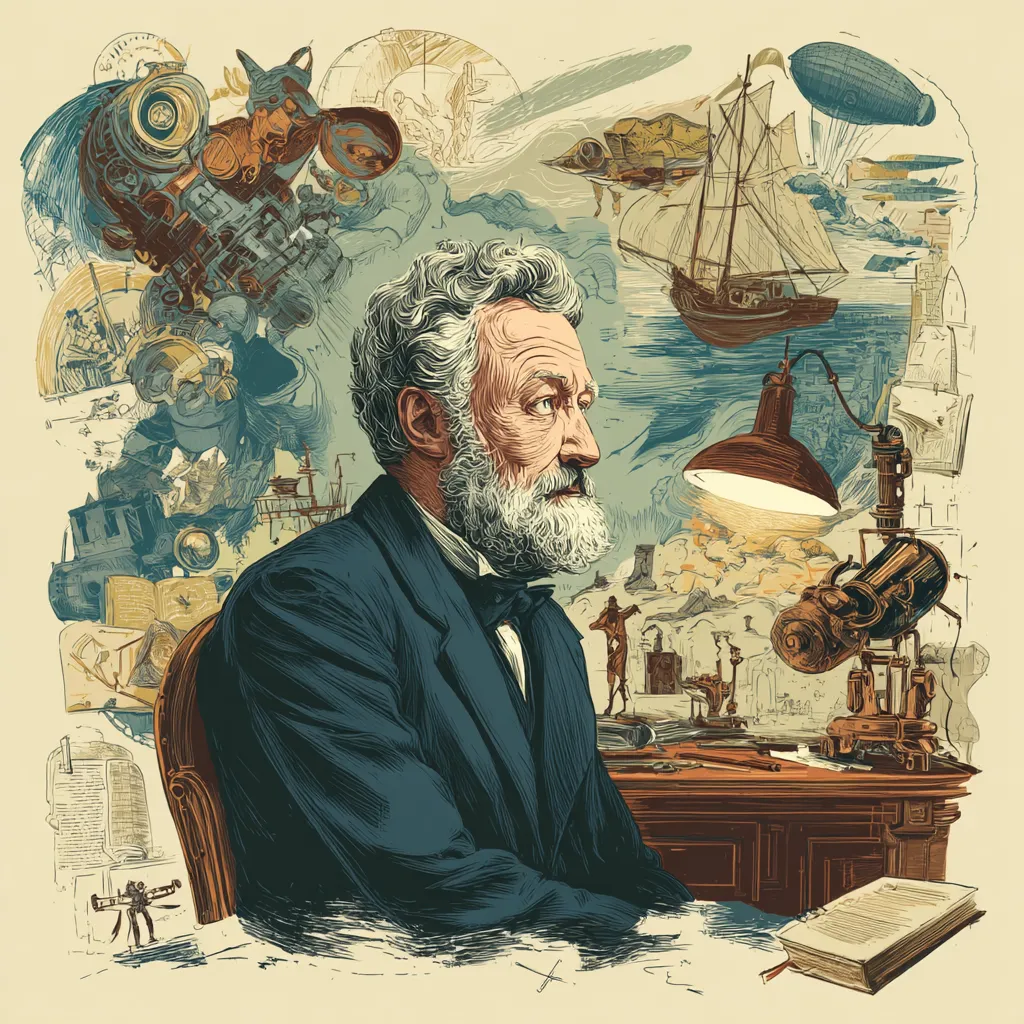
Jules Verne’s Influence on Science and Technology
Jules Verne’s work wasn’t just a form of escapism; it was a blueprint for future innovation. His novels served as both a form of entertainment and a call to action for scientists and engineers. His vivid imaginations about future technologies have inspired numerous inventors and explorers, some of whom have cited Verne as a key influence in their own work.
Popularizing Science and Innovation
Verne’s works made science exciting. He took abstract concepts like physics, chemistry, and astronomy, and presented them through thrilling adventures that anyone could enjoy. His books didn’t just entertain; they educated. Through characters like Captain Nemo and Professor Aronnax, Verne introduced readers to the wonders of the natural world and ignited their curiosity about the unknown.
In an era before advanced science communication, Verne became a bridge between scientific discoveries and the general public. His ability to make scientific knowledge accessible helped spark the imaginations of future generations of inventors and engineers.
Real-World Inventions Inspired by Verne’s Fiction
Perhaps the most impressive part of Verne’s legacy is how many of his fictional inventions inspired real-world technological developments. His submarine, the Nautilus, was closely mirrored by real-life submarines, including the Resurgam, which was developed shortly after Verne’s novel was published.
Likewise, his descriptions of space travel in From the Earth to the Moon were not lost on early pioneers in rocketry. Verne’s notion that space exploration would require international cooperation and cutting-edge technology likely influenced space exploration programs around the world.
In essence, Verne didn’t just predict the future — he helped shape it by inspiring the minds of inventors and scientists who sought to turn his visionary ideas into reality.
Exploring the Themes in Verne’s Work
Jules Verne’s work isn’t just about technology and adventure; it also explores deeper themes that resonate with readers today. His stories are filled with questions about the limits of human ambition, the pursuit of knowledge, and the ethical dilemmas of technological progress.
Adventure and Exploration
A dominant theme in Verne’s work is the spirit of adventure. His characters often venture into uncharted territories — whether it’s the depths of the ocean, the heart of the Earth, or the far reaches of space. Verne’s books tap into our innate curiosity about the world and our desire to explore the unknown. The thrill of discovery and the sense of adventure are key aspects that continue to draw readers to his books.
Man’s Relationship with Nature
Verne’s work often grapples with the relationship between man and nature. In novels like Journey to the Center of the Earth, Verne delves into the challenges humans face when they attempt to control or conquer natural forces. At the same time, his works convey a sense of respect for the mysteries of the Earth, suggesting that while we may seek to explore and understand nature, it’s something that remains beyond our complete control.
The Ethics of Technological Progress
Verne also delves into the ethical implications of technological progress. Captain Nemo, for example, is a brilliant inventor whose technological marvels are used in ways that raise moral questions. Through characters like Nemo, Verne explores the idea that great power, whether in the form of a machine or an idea, must be wielded responsibly.
Jules Verne’s Enduring Appeal Today
Even though Verne’s novels were written over a century ago, they remain as relevant today as they were when first published. In fact, his legacy is more powerful now than ever. As we continue to push the boundaries of space exploration, deep-sea research, and technological innovation, Verne’s works seem less like fiction and more like a forecast of the future.
Verne and the Modern Age of Technology
We live in an era where space tourism is no longer a fantasy, but a real possibility. Companies like SpaceX are working toward making interplanetary travel a reality. Advances in submarine technology and exploration have also brought Verne’s imagined world under the sea to life. The digital age and the rise of AI also bring to mind Verne’s visions of the future, where new technologies continually reshape the way we live.
Verne in Popular Culture
Verne’s works continue to inspire modern storytelling. Films, television shows, and even video games often draw from his imaginative concepts. Movies like 20,000 Leagues Under the Sea, Journey to the Center of the Earth, and Around the World in 80 Days have been adapted numerous times. Even today, filmmakers and game designers look to Verne’s adventurous plots for fresh ideas.
Frequently Asked Questions (FAQ)
Who was Jules Verne and why is he considered a visionary?
Jules Verne was a French writer whose works predicted modern technologies like submarines, airships, and space travel. His unique blend of science, adventure, and imagination made him a visionary in literature and science fiction.
What are some of Jules Verne’s most famous works?
Some of Verne’s most famous works include Twenty Thousand Leagues Under the Sea, Journey to the Center of the Earth, Around the World in 80 Days, and From the Earth to the Moon.
How did Jules Verne influence modern technology?
Verne’s futuristic ideas about space exploration, underwater travel, and airships influenced many of the early engineers and scientists who helped bring these technologies to life.
Conclusion: Jules Verne’s Timeless Legacy
Jules Verne was more than a novelist; he was a visionary who saw the world as it could be, not just as it was. His work continues to inspire new generations of readers, scientists, and explorers. From the depths of the sea to the far reaches of space, Verne’s ideas have shaped the course of human history. As we continue to innovate and explore, we can be sure that Jules Verne’s legacy will continue to guide us toward a future of endless possibilities. If you haven’t yet explored Verne’s works, there’s no better time than now. Dive into one of his novels — and who knows? You might just discover your own adventure waiting to unfold.
Call to Action
If you found this exploration of Jules Verne’s life and legacy fascinating, why not dive deeper into his books? Pick up a classic like Twenty Thousand Leagues Under the Sea and experience his visionary world firsthand. Want to discuss his ideas or share how Verne’s work has influenced your own thinking? Join the conversation in the comments below — we’d love to hear your thoughts!
Table of Contents
The Bullet and the Baby: Truth of a War Legend – trendsfocus