
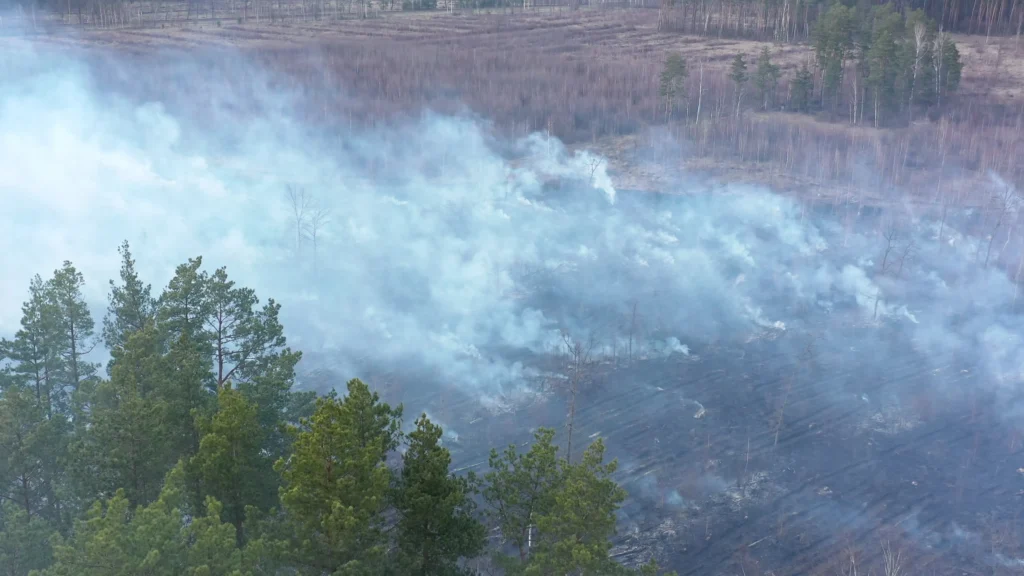
A wall of smoke rising above Spokane became the defining image of a frightening weekend for eastern Washington. What began as a brush fire in an open area west of the city rapidly developed into a major wildfire emergency, sending flames toward residential neighborhoods, forcing thousands of people to evacuate and leaving widespread damage in its path.
The Old Trails Fire began around midday on Saturday, August 1, near Old Trails Road in Spokane County. Strong winds, high temperatures and extremely dry vegetation allowed the flames to accelerate across grass and brush before moving north and east toward populated areas. Within hours, the fire crossed the Spokane River, threatened thousands of structures and created dangerous conditions on roads as families attempted to escape.
The unfolding disaster has affected far more than the land inside the fire perimeter. Residents have faced evacuation orders, power shutoffs, road closures and uncertainty about the condition of their homes. Hospitals and essential public facilities have also been disrupted, while firefighters from Washington and other states work under intense conditions to protect communities.
Early damage figures illustrate the scale of the emergency. Spokane County Fire District 3 Chief Cody Rohrbach said Sunday that approximately 640 structures had been destroyed by the Old Trails Fire. Because assessment teams were still examining burned neighborhoods, that number remained preliminary and could change.
For Spokane, this is not simply another distant wildfire producing smoke on the horizon. The fire entered the edges of the city, crossed natural barriers and reached areas where homes, businesses and public infrastructure stand close to dry forests and grasslands. It has become a deeply personal crisis for families throughout the region.
How the Old Trails Fire Spread So Quickly Across Spokane County
The Old Trails Fire was first reported at approximately noon on August 1. It initially burned through brush and grass, but weather conditions transformed it into a rapidly expanding incident. Strong winds pushed the flames toward neighborhoods, while high temperatures and dry fuels gave the fire the energy it needed to grow.
By Saturday evening, the fire had burned close to four square miles of terrain. State officials estimated that roughly 3,000 acres were active, while later mapping placed the burned area near 3,500 acres. Firefighters reported no containment Saturday evening, meaning crews had not yet established a secure perimeter capable of preventing further growth.
One of the most alarming developments occurred when the fire crossed the Spokane River. Rivers, highways and cleared areas can sometimes slow a wildfire, but wind can carry burning material across these barriers. Once the flames reached the opposite side of the river, additional neighborhoods and facilities faced an immediate threat.
People watching from highways and public areas could see orange flames and a massive column of smoke rising over the city. Roads quickly filled with vehicles as residents left evacuation zones. The combination of limited visibility, heavy traffic and rapidly changing fire behavior made the evacuation especially stressful.
The cause of the Old Trails Fire remained under investigation as of Sunday. Officials had not publicly confirmed how it started and urged the public to avoid speculation while investigators continued their work.
The speed of the fire highlights the danger of wildfires burning along the wildland-urban boundary. Spokane is surrounded by areas of forest, grass and brush that can become highly combustible during hot and windy summer weather. When development is located close to these landscapes, a fire can move from open land into residential streets with very little warning.
This is why evacuation notices should never be treated as predictions of what might happen later. They are instructions based on what emergency officials believe could happen within a rapidly changing situation. A neighborhood that appears safe at one moment can face smoke, embers or flames soon afterward when the wind changes direction.
Evacuations, Power Outages and Damage Disrupt Daily Life
Thousands of residents were ordered to leave their homes as the Old Trails Fire approached populated areas. Level 3 evacuation notices, commonly described as “Go Now” orders, were issued in the most threatened zones. Lower-level notices advised other residents to prepare to leave or remain alert for changing instructions.
The evacuations created long lines of cars as families attempted to move away from the flames. Many residents had only enough time to collect medications, important documents, pets and a limited number of personal belongings. Others left without knowing whether they would have a home to return to.
Major facilities were also evacuated. Spokane Mayor Lisa Brown said the affected locations included the Mann-Grandstaff Department of Veterans Affairs Medical Center, water reclamation infrastructure and the city’s waste-to-energy facility. Moving patients and employees from essential facilities added another layer of complexity to the emergency response.
Electricity service was disrupted across the region. Avista implemented public-safety power shutoffs in areas facing elevated fire danger, while other outages were connected to the broader emergency. State officials reported that approximately 60,000 people were without power at one stage of the crisis.
Although losing electricity creates serious difficulties for residents, intentional shutoffs may be used during extreme fire conditions to reduce the possibility that damaged electrical equipment will ignite another blaze. Power interruptions can still create additional risks for people who depend on medical equipment, air conditioning, refrigerated medication or electrically powered mobility devices.
The destruction reported Sunday gives a clearer picture of what residents were facing. Approximately 640 structures were believed to have been lost, according to the Spokane County fire chief. The term “structures” can include houses, garages, sheds, commercial buildings and other constructed property, so it should not automatically be interpreted as 640 homes. Damage-assessment teams will need time to determine precisely what was destroyed.
Behind every damaged building is a personal story. Families may have lost photographs, heirlooms, vehicles, livestock and the physical spaces in which they built their lives. Even residents whose homes survive may face smoke damage, spoiled food, interrupted employment and the emotional impact of a sudden evacuation.
Recovery will therefore extend far beyond containing the flames. Communities will need temporary housing, insurance assistance, debris removal, utility restoration and support for people coping with trauma and displacement.
A Statewide Fire Emergency Stretches Crews and Resources
The Spokane fires are part of a much larger wildfire emergency across Washington. State officials said fires had burned more than 250,000 acres, with approximately 4,000 personnel battling more than a dozen active incidents. Around 450,000 acres had burned in Washington during the summer by the beginning of August.
Governor Bob Ferguson declared a statewide emergency and burn ban as high winds and extreme temperatures increased the danger of additional fires. The National Weather Service also issued an unusually serious red-flag warning for eastern Washington, indicating that weather and fuel conditions could support extreme fire behavior.
The emergency declaration helps state agencies coordinate resources, mobilize personnel and provide support to local jurisdictions. Washington National Guard members were activated, and firefighters from more than a dozen states were assisting with the wider response.
For crews on the ground, containment involves far more than spraying water directly onto visible flames. Firefighters establish control lines, remove combustible vegetation, protect threatened buildings and monitor areas where embers could start new fires. Aircraft may drop water or fire retardant when visibility and wind conditions allow safe operations.
Wind remains one of the most difficult variables. It can cause flames to change direction suddenly, increase the intensity of the fire and carry embers far ahead of the main front. These spot fires can appear behind firefighters or inside neighborhoods that previously seemed outside the immediate danger zone.
Extreme heat also affects emergency personnel. Firefighters work in heavy protective clothing while carrying equipment across steep or uneven terrain. High temperatures increase the risk of dehydration, exhaustion and heat-related illness, requiring crews to rotate and receive logistical support.
At the same time, multiple fires compete for aircraft, engines, specialized teams and trained personnel. A large incident near Spokane can require resources that might otherwise be available for another community. Statewide coordination is therefore essential when dangerous conditions affect several regions simultaneously.
The response also depends on dispatchers, law-enforcement officers, utility workers, hospital employees, shelter volunteers, animal-rescue organizations and transportation personnel. Their work may be less visible than the crews standing beside the flames, but it is critical to moving residents to safety and keeping essential services operating.
What Spokane Residents Should Know as Conditions Continue to Change
The most important step for anyone near an affected area is to rely on official emergency information. Spokane County provides wildfire resources, evacuation maps and access to Alert Spokane, the county’s emergency notification system. Residents should check their addresses against current evacuation zones instead of relying on screenshots or social-media posts that may already be outdated.
A Level 1 notice generally means residents should remain alert and prepare. A Level 2 notice indicates a significant danger and means people should be ready to leave at a moment’s notice. A Level 3 notice means the danger is immediate and residents should evacuate without delay.
People under evacuation warnings should gather identification, medications, water, essential clothing, phone chargers and important documents. Pets should be placed in carriers or secured before conditions deteriorate. Vehicles should be positioned for departure, and residents should avoid parking in ways that could block emergency equipment.
Those outside evacuation zones can also help. Unnecessary travel near the fire can increase traffic congestion and interfere with emergency vehicles. Flying recreational drones near a wildfire is particularly dangerous because unauthorized aircraft can force firefighting planes and helicopters to suspend operations.
Smoke is another widespread concern. Wildfire smoke contains fine particles that can irritate the eyes and respiratory system. Children, older adults, pregnant people and individuals with heart or lung conditions may be especially vulnerable. Staying indoors, keeping windows closed and using appropriate air filtration can reduce exposure when outdoor air quality deteriorates.
Residents should also be cautious about fundraising appeals. Major disasters often lead to fraudulent donation requests. Contributions should be made through established charities, recognized community organizations or verified relief funds.
As Spokane confronts the immediate emergency, stories of neighbors helping neighbors are likely to become an important part of the recovery. Community members have opened their homes, assisted with animals, shared emergency information and supported people who had to leave with little notice.
The full impact of the Old Trails Fire will not be known until crews can safely enter all affected areas. Acreage, containment and damage estimates will continue to change as officials collect better information. What is already clear, however, is that the fire has profoundly disrupted the Spokane region and left many residents facing a difficult road ahead.
For now, the priorities remain straightforward: protect lives, follow evacuation orders, keep roads accessible for emergency crews and obtain information from official sources. The flames may eventually be contained, but rebuilding homes, restoring essential services and helping displaced families recover will require a long-term community effort.
Table of Contents
Live updates: Washington wildfires in Spokane County; hundreds of structures destroyed | CNN
Zohran Mamdani Defends Affordable Grocery Stores – trendsfocus